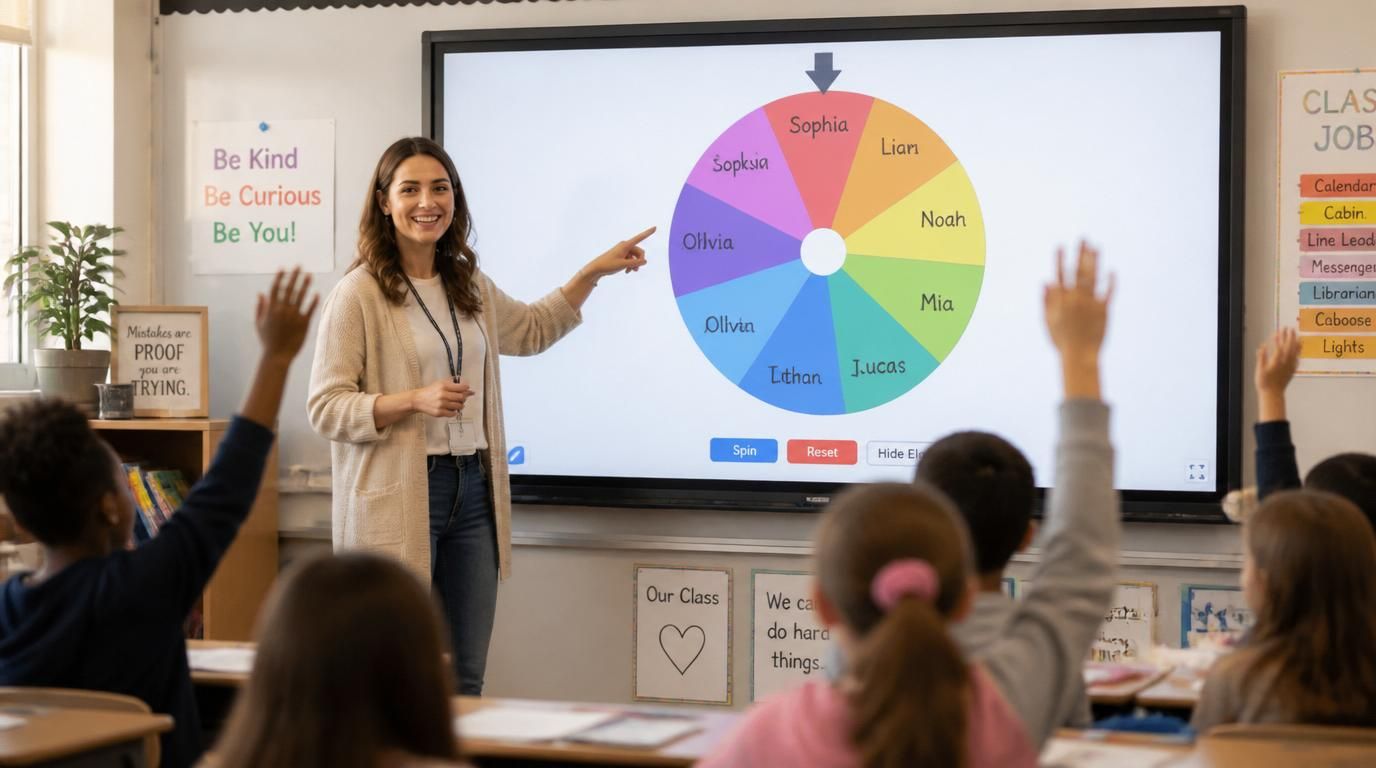
The first time a name picker actually changes a classroom is almost never the first time it's used. It's the third week, after the teacher has worked out the small rules — when to reset the list, what to do when someone's absent, how to handle the student who freezes — and the whole class has stopped reacting to the spin itself and started reacting to the question.
This article is the version of those notes we wish we'd had at the start. Not the marketing pitch for any single tool, just the practical rules that make a classroom name picker actually useful instead of a gimmick that wears off in a week.
Why random calling helps in the first place
The default in most classrooms is hand-raising, and the default in most classrooms is also that the same four students raise their hands. There's a quiet bargain: those four take the pressure off everyone else, the teacher keeps the lesson moving, and over the course of a year the other students stop preparing answers because they know they probably won't be asked.
A random name picker breaks that bargain in the simplest possible way. Once the class knows anyone might be called next, the cost of not preparing an answer goes up. Doug Lemov calls a version of this "cold call" in Teach Like a Champion, and the supporting cognitive-science argument — retrieval practice, desirable difficulty — is well documented. A spinner is just the most theatrical, lowest-friction way to operationalize it.
But the tool is the easy part. The rules around it are what decide whether it works.
Rule 1: Remove after spin during an activity, reset between activities
"Remove after spin" is the single setting that does the most work. Within one activity — discussing a passage, going around for warm-up answers, reviewing homework — the wheel should remove each name as it's picked, so every student gets called exactly once before anyone gets called twice. That's the fairness the students will actually notice.
Between activities, reset. If you let the removal carry across the whole period, two things go wrong. First, students who were picked early stop paying attention because they know they're "safe" for the next forty minutes. Second, students who haven't been picked notice the imbalance and start performing nervously, which kills the natural participation you were trying to build.
Rule 2: Handle absences silently
When the wheel lands on a student who isn't there, the temptation is to announce it — "oh, Maya's out today" — and re-spin. Don't. Three reasons:
- It tells the rest of the class who's absent, which is information they don't need and which the absent student didn't consent to share.
- It breaks the rhythm of the lesson. The spin is supposed to feel like a quick coin flip, not a roll call.
- When the student comes back and hears "the wheel landed on you Tuesday but you weren't here," they feel singled out for an arbitrary reason.
Better workflow: glance at the result, see who's absent, click spin again. The whole class barely notices the second spin if you don't draw attention to it.
Rule 3: Build a "pass once, return once" norm
The hardest case is the student who freezes when called. Most teachers' instinct is one of two extremes: either let the student off entirely (which trains the class that the wheel is bluffable) or push through the silence (which makes the wheel feel punitive).
A middle path that holds up in practice: the picked student can pass to one peer of their choice, but the wheel returns to them at the end of the segment with a smaller question. "Pass to a friend now, but I'll come back to you for the example sentence." It preserves the no-opt-out norm without making the spinner feel like a trap.
Rule 4: Pair the spin with three seconds of think time
This is the change that does more for answer quality than any setting on the wheel itself. The instant the spinner stops, don't ask the question yet. Say the question first, count three beats silently, then spin. Every student in the room has to prepare an answer in those three seconds because none of them know yet who'll be called.
If you spin first and ask the question after, you've reverted to a one-student exercise. The other 28 know they're off the hook and stop thinking.
Rule 5: Don't run the spinner more than twice per lesson
Novelty is doing more work than people realize. The first spin of a lesson is genuinely attention-grabbing. The second still feels purposeful. By the fourth, the students have stopped looking up. The animation that used to pull eyes back to the board is now ambient noise.
Pick the two highest-stakes moments in the lesson — usually the warm-up call and the comprehension check — and reserve the wheel for those. Use hand-raising and partner-talk for everything else. The contrast is what makes the spinner land.
Rule 6: Share the list, not the link
If you're co-teaching or sharing the class with a colleague, share the roster file (a plain text list of names), not a link to a saved wheel. Saved wheels drift — one teacher edits the order, another teacher resets the removed names, and now two sections of the same class are running different wheels.
Keep one source-of-truth roster in your gradebook or sheet, paste it fresh into the wheel each day, and you'll never have the "wait, why is Jordan on this list twice" conversation.
What changes in week three
The thing nobody warns you about is that the spinner stops feeling like the activity within a few weeks. It becomes the punctuation. Students stop watching the wheel and start watching each other. Hand-raisers raise less, because they know they'll be called anyway. Quiet students prepare more, because they know they might be next. The wheel itself becomes background.
That's when you know it's working. The tool was never the point — the participation norm it built is.
If you want to try the workflow above with your own roster, paste it into the free name picker wheel, turn on remove-after-spin, and run the next lesson with the three-second pre-spin pause. You'll feel the difference inside one class.
