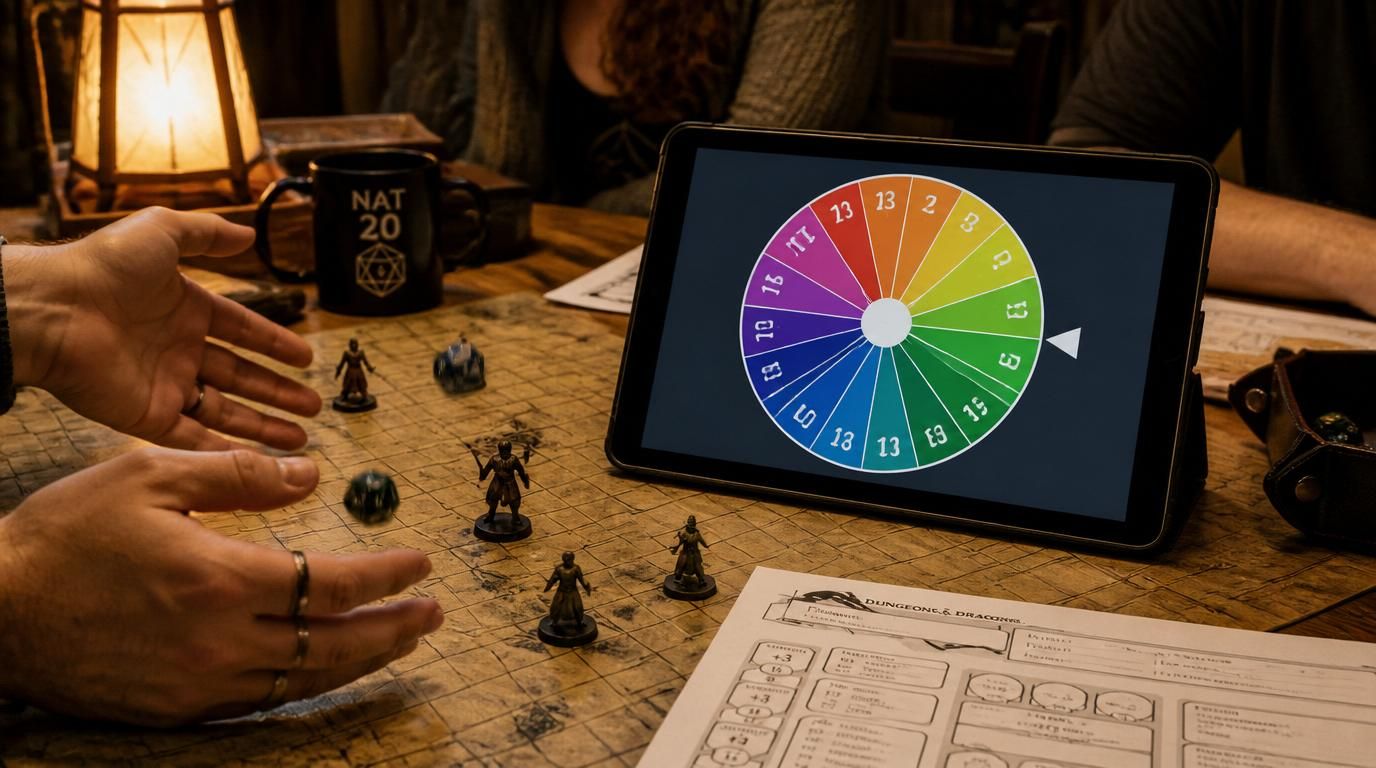
The argument over whether physical dice or online dice rollers are "more random" usually misses what's actually being asked. Physical dice are demonstrably biased in ways online rollers aren't. Online rollers are demonstrably less fun in ways physical dice are. Both statements are true, and the right tool depends on what kind of game you're at.
Why physical dice are slightly biased
This isn't a theoretical concern. A d20 from any mass-market manufacturer has, on average, a few percent bias on individual faces — some show up slightly more often than 1-in-20, some slightly less. The reasons are mechanical: injection-molded dice have small density variations from the air pockets that form during cooling, the numbered pips remove tiny amounts of mass per face, and the dice get worn unevenly during use.
For a single roll, none of this matters. Over 50 rolls in a session, none of it matters. Over 500 rolls in a long campaign, the bias starts to show — usually in the form of a slightly higher critical-fail rate than the player expected, or a slightly lower critical-hit rate. The effect is small and easily lost in the noise of perception bias ("my dice hate me tonight"), but it's real.
Casino-grade dice are precision-machined and balance-tested to eliminate this. Most tabletop dice aren't. This is the trade-off you accept in exchange for the tactile experience.
Why online dice are not
An online dice roller uses a pseudo-random number generator that produces a uniform distribution across however many faces you specify. The statistical quality is overwhelming compared to what any tabletop game needs. The concerns people raise — "but is it really random?" — apply to cryptographic contexts, not to whether your fireball hits.
For the question of which is "fairer," online rollers win on math. Every face has exactly the probability it's supposed to. Over 500 rolls, you'll see the expected distribution. Over 50,000 rolls, you'll still see the expected distribution.
Why this doesn't settle it
Because fairness isn't the only thing the dice do at a table. The roll is part of the game. The moment of picking up the dice, the throw, the slow stop, the reaction — that's not a wrapper around the random number, that is the game for a meaningful fraction of the players. A digital roll replaces that with a screen animation and a result, which is cleaner and emptier in equal measure.
The same group that would be horrified by a DM rolling behind the screen is happy to use physical dice in the open. The transparency of the table — everyone sees the result the moment it lands — is doing most of the fairness work. Bias of a percent or two doesn't undo that.
The case for digital, by context
Three contexts where online dice are the right call:
- Remote play. Asking remote players to roll physical dice off-camera is asking them to be implicitly trusted by the rest of the table. Some groups handle this fine; most prefer the no-trust-required model where everyone uses the same digital roller.
- Tournament or PvP play. When the stakes of a roll are high and an authoritative log matters, digital rollers produce a record that physical dice can't.
- When suspicion has already entered the table. Once someone has commented on another player's dice being "lucky," the trust is harder to restore than to replace. Switching to a shared digital roller for the rest of the campaign defuses the question without anyone having to be accused.
The case for physical, by context
In-person play, especially with players who care about the ritual: physical dice every time. The marginal bias is a price worth paying for the table experience. If you're worried about bias specifically, buy a set of casino-grade or precision-balanced dice; the bias is significantly lower and the cost is manageable.
The hybrid setup that works
Most hybrid groups (some in-person, some remote) settle on the same arrangement: in-person players roll physical, remote players roll digital, the DM trusts both. There's a small fairness asymmetry — the remote players are technically rolling cleaner numbers — but it's vastly smaller than the asymmetry of asking remote players to roll off-camera.
The DM, in this setup, should usually roll digitally even when in-person. It removes the "DM fudged that" question from the table for the entire campaign.
What about damage rolls
If you're going to partially digitize a campaign, damage rolls are the cleaner ones to switch. Damage is additive across multiple dice, which evens out per-die bias faster than single-die attack rolls. The table moment is also lower-stakes for damage than for attack — a critical attack is a memorable beat; the damage that follows is the postscript.
This is one of those decisions that should be made by the table, not by the DM unilaterally. The point of switching tools is to align the group on fairness; sneaking the change in defeats the purpose.
The honest summary
Online dice are fairer. Physical dice are more fun. For most casual in-person tables, fun wins by a wide margin and the small fairness cost is invisible in practice. For remote, competitive, or trust-strained tables, fairness wins and a shared online roller is the right call.
If you need an online roller for the remote half of your table or for a one-off check, use a virtual dice roller that supports the dice your system needs and gets out of the way. The right tool for the right table — not "physical good, digital bad" or the reverse.
