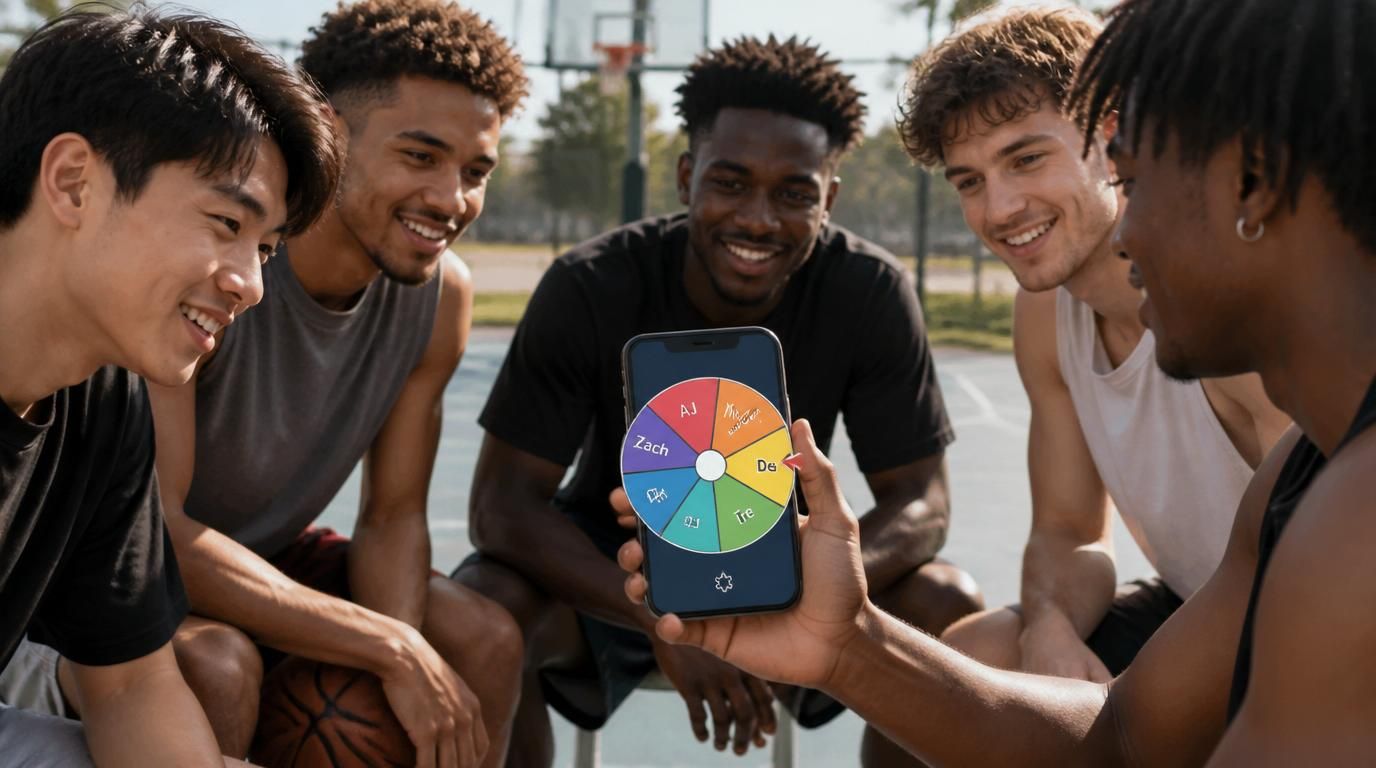
Two years into running a weekly pickup soccer group, we tried every team-picking method that exists. Captains pick: takes ten minutes and embarrasses whoever gets picked last. Snake draft: same problem, just polite. Pure random: blowouts every other week. The "random plus a do-over if it looks bad" method: not random anymore, and everyone notices.
What actually works is stratified random — tier the players first, then randomize within tiers. It takes about 90 seconds with a spinner and produces games that go down to the last five minutes most of the time. Here's the exact workflow.
Why pure random fails so often
In a typical 10-player pickup group, skill follows a long tail. You have one or two players who'd be on the bench of a competitive amateur team, three or four who play regularly and know what they're doing, and three or four who are there for the run and the postgame beer. Pure random has roughly a one-in-three chance of putting both top players on the same side — and when that happens, the score is 6–1 by the time anyone's warmed up.
The math is the only thing surprising about this. We just assumed for a long time that pure random was "the fair option," and that anything else was matchmaking. It's not. Stratified random is still random — the assignment within each tier is fully chance-based — it just constrains the chance so that one team can't end up with both top players.
The 90-second workflow
Step 1: Confirm who's playing
Group chat, two-minute count. Anyone who hasn't confirmed in the last ten minutes is out — pickup chemistry depends on knowing who's actually showing.
Step 2: Mentally sort into three tiers
The organizer (one person) does this silently, takes about 15 seconds:
- Tier A — Carries. The two or three players whose presence on a team materially changes the game. Usually obvious.
- Tier B — Regulars. Everyone who plays most weeks and knows the group's rhythm.
- Tier C — Casuals. Newer faces, occasional players, or anyone explicitly here to learn.
Don't share the tiers with the group. Nobody needs to see "you are a Tier C player" on a screen. The tiers exist only to constrain the spinner.
Step 3: Spin each tier separately
Open a random team generator. For each tier, paste those names and split into 2. Combine the results: Team 1 gets the first half of Tier A, the first half of Tier B, the first half of Tier C. Team 2 gets the rest.
For tiers with odd counts, the extra goes to the team with fewer total players, or — if it's still tied — alternates per tier.
Step 4: Announce the teams as a single list
"Team Bibs: Alex, Sam, Priya, Jordan, Kai. Team Skins: Maya, Dev, Chris, Lena, Tomás." No tier labels visible. The teams look completely random to the players, because within each tier they are completely random.
Why this still feels random
The trick we didn't expect: even players who know stratified random is being used can't predict who they'll play with. The Tier A player doesn't know which Tier B players will land on their side. The Tier C player has the same uncertainty everyone else does. The spinner result feels exactly like a coin flip from the inside, because for every individual player it basically is.
The only thing the constraint removes is the worst-case outcome where all the strongest players bunch up. Everything else — who plays alongside whom, who's matched against their friend, who ends up defending the goal — is genuine chance.
Handling the awkward cases
Uneven numbers (e.g. 11 players for 2 teams of 5). The extra player goes on the team that lost the previous week. First week of a season: extra player goes on the team whose top-tier player is weaker. Decide before you spin.
A player asks "why am I on this team." Honest answer: "The spinner put you there." That's true. The tiering constrains the spinner, but the actual assignment is random.
Someone wants to play with a specific friend. One pickup group we know runs a "request swap" rule after the draw: any player can request to swap with one player on the other team, no questions asked. If the other player agrees, the swap happens. If not, it doesn't. This works because it's symmetric and visible.
A regular doesn't show. Re-spin. Don't try to manually rebalance after the fact — that's the move that gets people accusing the organizer of stacking.
What changes in the season
The biggest shift from this workflow isn't that any individual game gets more competitive — though it does. It's that the postgame conversation changes. With pure random, half the conversations are "we got rolled because the wheel hated us." With stratified random, the conversation is about plays, not about the draw. The team selection stops being a topic.
That's the actual product. A team generator that disappears into the background, leaving the game itself as the only thing worth talking about.
If you run a weekly group, try the workflow above for two weeks. Three tiers, separate spins per tier, no tier labels in the announcement. Track how often the games stay within two goals or two baskets. Almost every group we've seen this with reports a meaningful shift inside a month.
