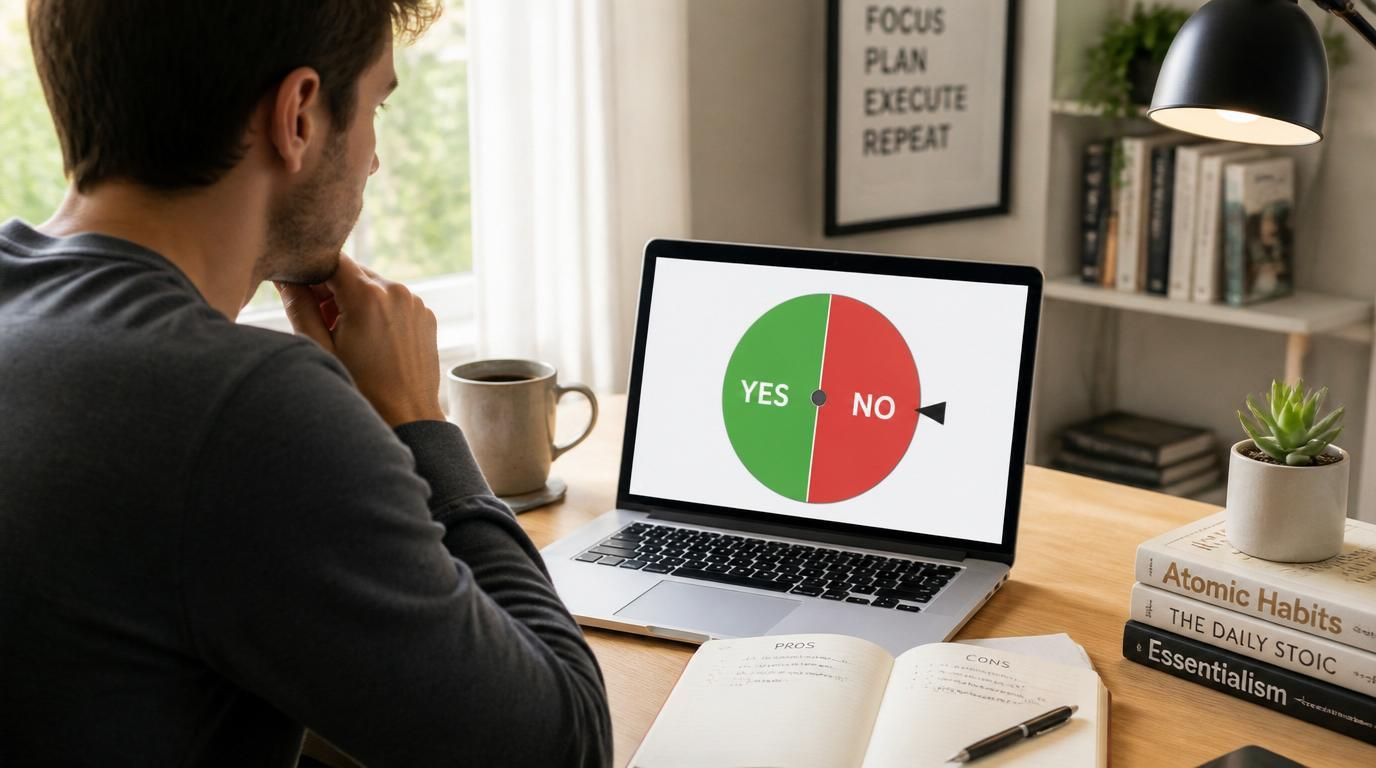
There's a moment in a lot of small decisions where you've already weighed both options, both are fine, and you're now spending more mental energy on the choice than either outcome is worth. That's the band a yes-or-no wheel is built for. Outside of it, the wheel is either redundant (a coin works) or actively harmful (you're avoiding a decision that deserves attention).
Here's how to tell the difference.
The decision band where it actually helps
The wheel is useful when all three of these are true:
- The outcomes are roughly equivalent in cost. Walk left or walk right after dinner. Get the iced coffee or the hot one. Push the gym session to tomorrow or do a short one tonight.
- The decision has been stalled for more than a minute. You've already cycled through the pros and cons. Nothing new is going to surface.
- You don't have a strong gut preference. If you actually want one of them, the spinner is theater — you'll re-spin until you get it.
Inside that band, the wheel works because it externalizes the commitment. The decision happened; you just needed something to make it final. Outside that band, it doesn't.
Why the spin beats a coin flip (slightly)
The honest answer is that a coin flip is mathematically equivalent. The reason a yes-or-no wheel sometimes feels better isn't the randomness — it's the duration. A coin flip is over in half a second. A wheel spin lasts three to five seconds, and during those seconds something useful happens: your brain notices which result you're hoping for.
That "last-second preference" is the wheel's actual product. If the spin is slowing down and you realize you want yes, do yes. The wheel just helped you find an answer you didn't know you had. If you genuinely don't care which way it lands, accept the result and move on. Either way, the decision is resolved.
The mistake: using it for real decisions
"Should I take the job?" "Should I break up with this person?" "Should we move?" None of these belong on a yes-or-no wheel, and using the wheel for them is a way of avoiding the harder work the decision needs.
The tell is simple: if you'd be upset with whichever result the wheel lands on, the wheel can't help. You need a longer conversation, a list of constraints, a sleep-on-it night, advice from someone who knows the situation. Outsourcing those decisions to a spinner doesn't reduce the cost of getting them wrong — it just makes the wrong choice feel impersonal instead of considered.
The couples-and-kids version
The wheel works best in households as a tiebreaker for symmetric situations: which movie tonight, whose turn to take the dog out, what side of the bed when traveling. Both people can live with either result; both people accept the spin in advance.
It fails — and we've seen this in our own houses — when one person clearly cares more about the outcome than the other. Spinning a yes/no wheel for "do we visit your parents this weekend" when one partner has been dreading it for a week isn't fair, even though the spin is technically 50/50. The fairness was lost at the point of asking the spinner instead of having the conversation.
With kids, the same rule scales down. The wheel decides which game first, whose turn to pick the bedtime story, who sits in the front seat. It does not decide whether dessert is allowed. Adults set the boundaries; the wheel is one of the random rotation tools that operate inside them.
The drift problem
The biggest long-term failure mode of a yes-or-no wheel is reaching for it too often. The first few uses feel decisive and good. Use it five times a day and it stops working — partly because the novelty wears off, partly because you start noticing that "the wheel said no" is just a more elaborate version of "I didn't feel like it."
A useful self-rule: the wheel gets one use per day at most. If you reach for it a second time, ask whether you're actually using it for decisions or for permission to not decide. The honest answer is usually the second one.
What to do when you don't trust the result
The wheel landed on yes. You don't want yes. Three options, in order of how often they actually serve you:
- Do no anyway. The wheel surfaced your real preference. That's the whole point. Don't spin again — just go with what you now know you wanted.
- Spin twice more, best of three. Useful occasionally, but if you find yourself doing this often, the decision wasn't actually 50/50 and you should stop using the wheel for it.
- Re-spin until you like the result. Don't. This is the failure mode that makes people lose faith in any decision tool, including their own judgment. If you're going to override the spinner, override it once, knowingly, and don't pretend the spinner had a vote.
The minimal use case
If you only ever use a yes-or-no wheel for the 30-second decisions at the end of the day — left or right after dinner, this show or that show, the second coffee or no — you'll get most of its value and avoid all of its traps. Anything larger than that, talk it out or sleep on it. The wheel isn't built to carry weight.
