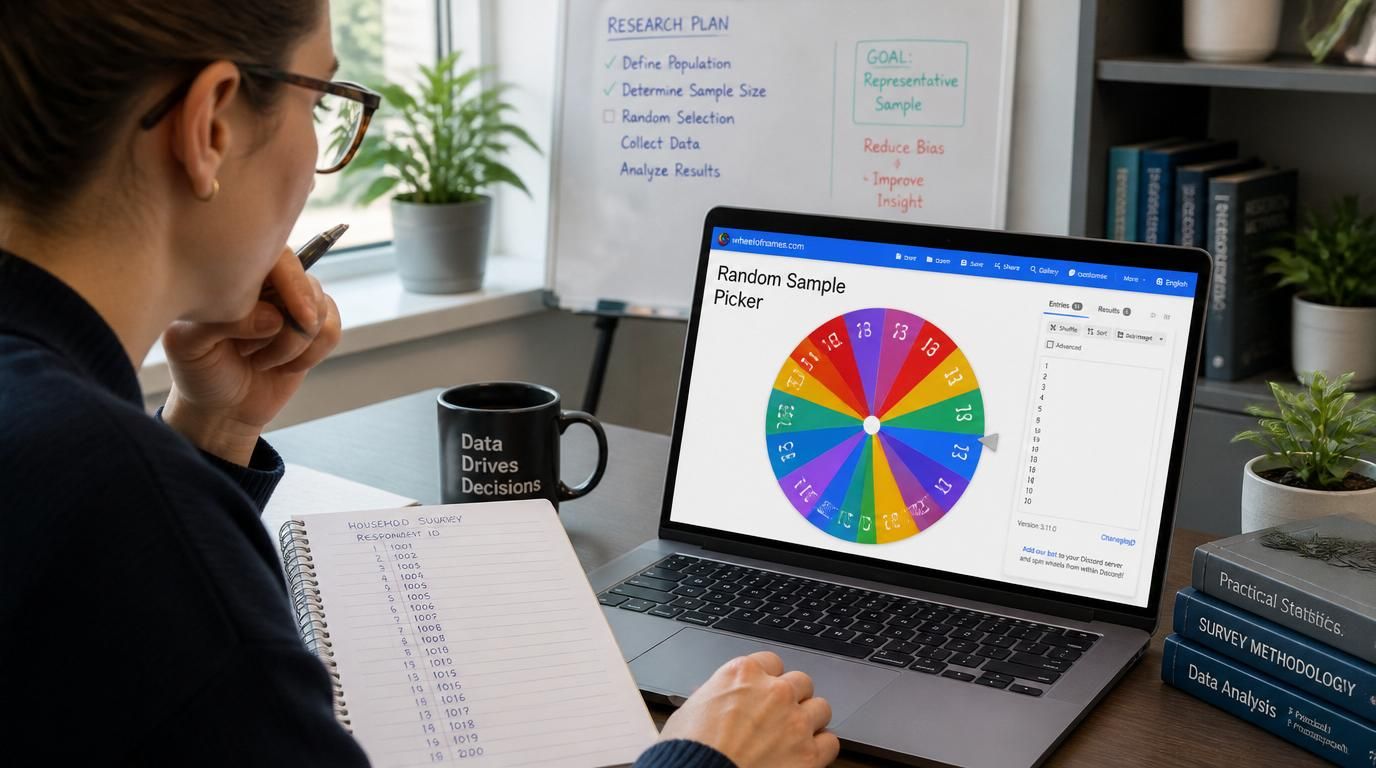
A random number generator gets thought of as a raffle tool. That's its most visible use, but it's not where most of its actual usefulness lives. The RNG sits one click away in a browser tab, and once you've used it a few times for small daily decisions you start noticing how often the alternative — debating, deferring, defaulting to whoever speaks loudest — was costing more time than the decision deserved.
Here are the day-to-day uses that don't show up in marketing copy for RNG tools but do show up in everyday households and teams.
Chore rotations that don't feel rigged
Every household with more than one person has tried at least one chore rotation system, and most of them fail for the same reason: the system feels arbitrary or — worse — feels like it favors someone. An RNG solves this by being demonstrably indifferent.
The version we use: number every household member 1 through N. Once a week (we do it Sunday evening), generate a number from 1 to N. That person gets the worst chore for the week. The next week, generate again — and yes, the same person can get picked twice in a row. That's the point. Anything that smooths out the "same person twice" possibility is sneaking determinism back into the system, and people will eventually notice.
Over a year this averages out cleanly. In any given month it doesn't. Accept the variance — it's the price of the system being trustworthy.
Page-number reading club
A small reading habit that's worked in our group for two years: pick a long-ish reference book or essay collection. Generate a random page number each morning. Read that page over coffee. Some days you land on context you don't have; some days you land on a sentence that sticks. Either way, you've read a page you wouldn't have picked deliberately, which is most of the point.
This works better than linear reading for books you'd never finish front-to-back. The randomness is the feature, not a workaround.
Classroom call-outs by seat number
For teachers who don't want to use a name picker (because absences make name pickers awkward) but still want non-volunteer participation: number the seats, generate a number from 1 to the row count, ask the question to whoever is in that seat today. Empty seat? Generate again, no announcement.
The advantage over a name picker: nobody's name appears on screen. The "spotlight" feeling is reduced. Some classes prefer this; others prefer the name-on-screen approach. Both work — knowing the option exists matters.
The "what to work on next" trick
For solo work with multiple open threads — design tasks, writing projects, anything where the next step is unclear — list the threads 1 through N and generate a number. Whatever it lands on, work on that for the next 25 minutes. If at the end of 25 minutes you're in flow, keep going. If not, generate again.
This sounds gimmicky and works far better than it has any right to. The reason: most of the cost of switching tasks is the "what should I be doing right now" decision. Outsourcing that decision to an RNG removes the cost without removing the ability to override (the 25-minute checkpoint is your override).
Group order for anything
Reading order in a book club. Speaking order in a meeting. Round order in any game. Number the participants, generate the order in one pass. Done in five seconds, perceived as fair because it is fair, removes the awkward "you go first / no, you go first" loop that eats meeting time.
For groups that meet repeatedly, you can do this once at the start and follow the order all session, or generate fresh each round. Either works; pick one and be consistent.
The "which one am I keeping" decision
Decluttering hits a wall when you have two equivalent items and can't choose which to keep. Number them, generate a 1 or 2, keep whichever it picks. This is one of those places where the spinner-style "best of three" doesn't apply — if you re-roll until you get the answer you wanted, you've revealed which one you actually wanted to keep. Trust the first result and the closet gets cleaner.
Tournament tiebreakers
For brackets, leagues, or competitions where two teams or players are tied on points and a tiebreaker is needed: generate a number from 1 to N where N is the number of tied parties, ranked in whatever order the result implies. The key is to agree on the rule before the tie happens, document it, and run the generator publicly when the time comes.
An RNG used as a tiebreaker after the fact, without prior agreement, feels arbitrary even though it's fair. An RNG used as a tiebreaker per a pre-stated rule feels procedural and is universally accepted.
Birthday-style party games
"Pick a number between 1 and 100" works as a 30-second party game where one person thinks of a number, others guess, and the closest wins. Replace the thinking-of-a-number step with an RNG run on your phone, and the game is suddenly indisputable — there's no "I was thinking of 73 the whole time" challenge. The number is recorded the moment it's generated; everyone can see it after the guesses are in.
Why the right range matters
The single most common mistake people make with RNGs: using a range that's too wide. If you have six options, generate from 1 to 6, not from 1 to 1,000. The 1–1,000 version technically works but makes every result feel arbitrary ("742? what does that even mean?"). The 1–6 version maps cleanly to your choices and feels like a rolled die, which is exactly the cognitive shortcut you want.
The right range, the right context, and the right amount of trust between the people involved — that's the whole RNG workflow. The randomness itself is the easy part.
If you don't already have an RNG tab bookmarked, the small daily decisions are where it earns its keep. Try one of the above for a week.
